← Back to Blog


The feed and ChatGPT reward different posts. Here's how founders write for both.
TL;DR: A LinkedIn content strategy for founders in 2026 has two readers: the feed, and the AI engines that pull answers from LinkedIn. Per Semrush, LinkedIn appears in 11% of ChatGPT Search, Google AI Mode and Perplexity responses, and per Profound it's the most-cited domain for professional queries. Scrunch found the two readers reward different posts: Unicode bold and links in the comments earn more reactions while cutting ChatGPT citation odds by 58% and 31%. Below are six moves that work for both.
A LinkedIn content strategy for founders is a repeatable writing plan in which the founder or CEO answers, from their personal profile, the questions their buyers actually ask, so each post performs in the feed and also becomes a source AI engines quote. That second part is new, and it's what this article is about.
Your next post gets two lives. The first one lasts about two days in the feed. The second happens months later, inside a ChatGPT or Perplexity answer, long after everyone scrolled past it (assuming you wrote it in a way a machine can use).
On September 2, Buffer published a piece by Violeta Maftei on an AEO workflow that finds the questions where a brand is missing from AI answers and turns them into LinkedIn post briefs. By the time it reached my feed, it had been compressed to "LinkedIn is the most-cited domain in AI search." I went to the source. The actual claim is more careful, and more useful, because it rests on two different studies.
Why AI engines read LinkedIn at all
Semrush (March 2026). Margarita Loktionova's team analyzed 325,000 prompts from January and February 2026. LinkedIn came in second, behind Reddit, appearing in 11% of AI responses on average. The spread between engines is wide: 14.3% of ChatGPT Search responses, 13.5% in Google AI Mode, and only 5.3% on Perplexity.
Profound (March 2026). Davis McCain (research) and Brandon Punturo (Member of Technical Staff) looked at 1.4 million citations and narrowed in on professional queries (career, B2B, software, industry). There, LinkedIn is the #1 most-cited domain across all six AI platforms they track. On ChatGPT alone, it climbed from roughly #11 in November 2025 to #5 by February 2026.
So the accurate version: second overall, first for professional questions. If you sell B2B, professional questions are your whole market.
The detail I'd actually build a strategy around is what gets cited inside LinkedIn. On ChatGPT, profiles fell from 33.9% to 14.5% of LinkedIn citations in three months, while posts rose from 20.9% to 26.0%. Your profile still does the landing-page job (here are LinkedIn profile examples that do it well). What the engines increasingly quote is what you publish.
As for who gets cited, personal profiles versus company pages, I covered that in ChatGPT Doesn't Read Your Company Page. This piece is about how to write.
The feed and ChatGPT want different posts
In May 2026, Michael Iannelli at Scrunch published a study that measured the same posts from both directions: reactions on LinkedIn and the odds of being cited by ChatGPT. The dataset was 12,000 observations of LinkedIn posts in ChatGPT answers (January 15 to April 15, 2026) plus about 4,000 posts scored for citations and reactions, controlling for audience size and post age.
Post feature | LinkedIn reactions | ChatGPT citation odds |
|---|---|---|
Unicode bold/italic formatting | +12% | −58% |
Link in the first comment | +11% | −31% |
Technical details | n/a | +77% |
Named entities (companies, people, products) | n/a | +33% |
Topic specificity | n/a | +18% |
And the finding that matters most for founders: reaction counts have near-zero effect on whether ChatGPT cites a post.
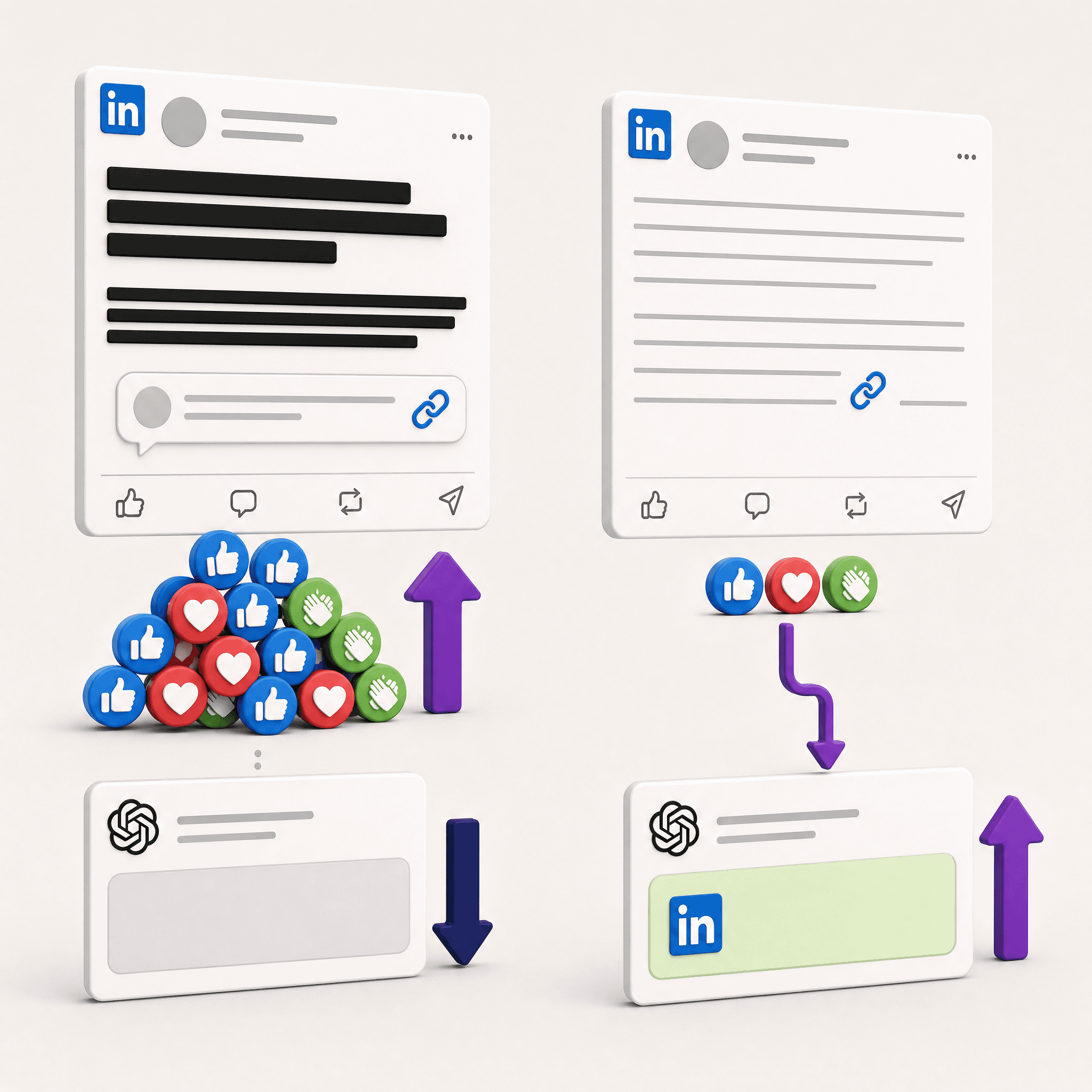
I have to own something here. "Put the link in the first comment" is a rule we all recite, and in my company-page article I even quoted Metricool's number, a 27% reach penalty for a link in the body of a personal-profile post. That's still true for the feed. It now has a price on the other side, and a founder who applies the rule to every post is quietly giving up about a third of their citation odds.
How to write LinkedIn posts AI engines cite: six moves
1. Start from the question your buyer types
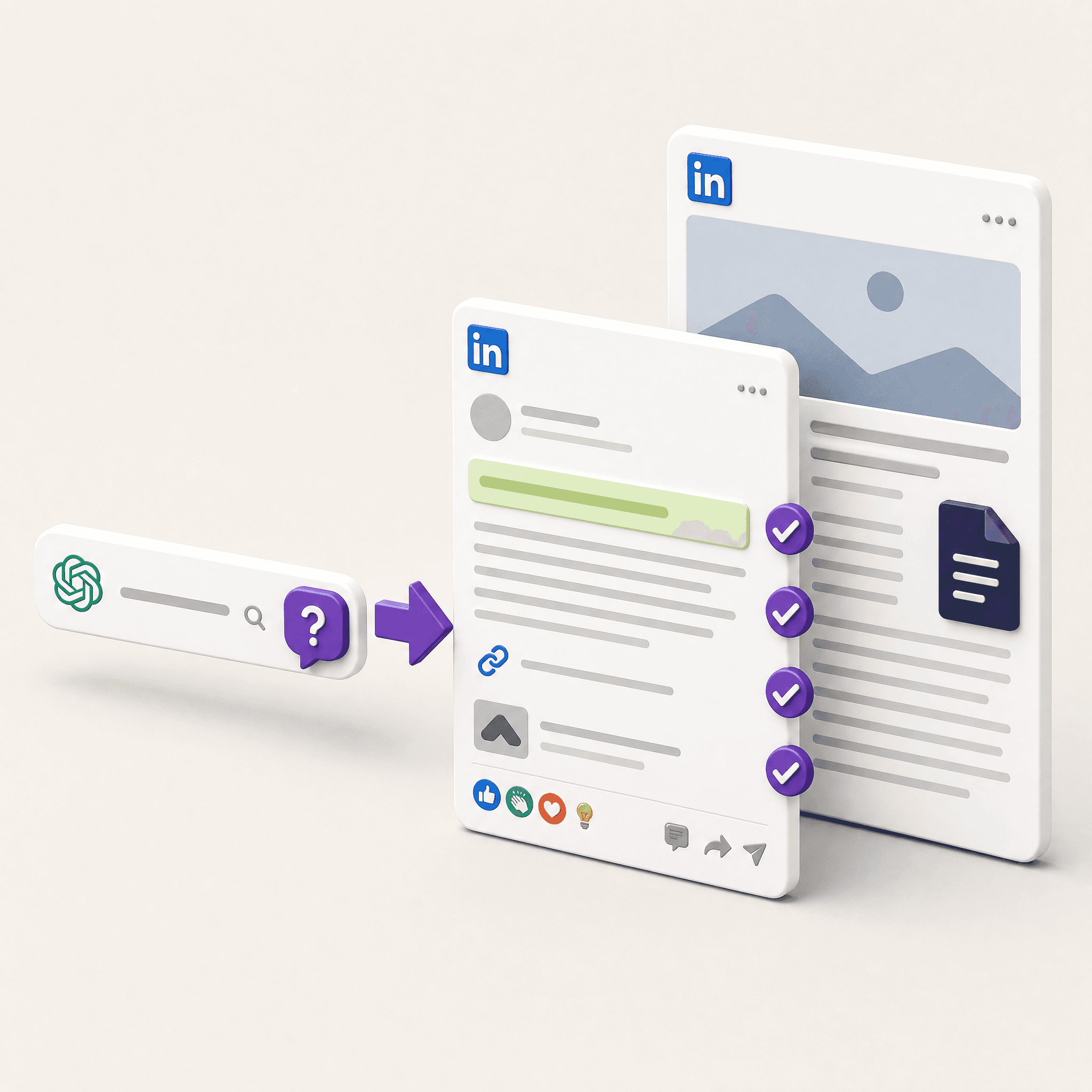
Buffer's workflow uses Peec AI to track the prompts where a brand is absent. If you don't have a tool budget, the free version lives in your calendar: sales calls.
A question you heard on three calls → type it into ChatGPT and Perplexity and note who gets cited → write a post that answers it directly → if the question is big, expand it into a LinkedIn article → check again in a month.
2. Make the first line the answer
The structure Buffer recommends, based on the data: 50 to 299 words, no Unicode bold, link in the body, direct address, and an opening that states the answer. The feed is fine with this. A sharp answer in line one is as good a hook as a riddle that forces a "see more" click, and it's a lot less annoying.
3. Load it with specifics
Technical details and named entities are the two strongest variables in the Scrunch data. "We improved customer onboarding" gives an engine nothing to hold. "We cut onboarding from three weeks to eight days by moving SSO setup before the training call" gives it a quotable fact (and happens to sound like someone who did the work).
4. Short posts, plus articles for the big questions
Per Semrush, posts of 50 to 299 words make up the largest share of cited posts. But LinkedIn articles account for 50% to 66% of all cited LinkedIn content, versus 15% to 28% for posts, and the most-cited articles run 500 to 2,000 words. A founder who only posts is playing on the smaller half of the board. Once a month, take the question that earned the most saves or DMs and turn it into an article.
5. Plain text only
Skip the "bold text generators." Those characters are mathematical symbols that happen to look like letters, so a machine reads your emphasis as noise. You give up 12% more reactions and keep your citation odds. Readers are getting less patient with manufactured-looking posts anyway, which is exactly why LinkedIn added an AI slop report button.
6. Decide the link post by post
An answer post (a buyer question, a how-to, data) gets the link in the body. A post whose only job is conversation in the feed gets the link in the comments. In my experience with founders, the posts that bring in customers are usually the first kind.
Consistency beats virality
This is the part of the Semrush study that should shape any LinkedIn content strategy for founders. The median cited post has 15 to 25 reactions and at most one comment. Nearly half of cited authors have more than 2,000 followers, which means the rest have fewer. About 95% of cited posts are original, and reshares are just 5%.
What does repeat: nearly three quarters of cited authors publish five or more posts in four weeks, and 54% to 64% of cited content is knowledge or advice. A founder with 900 followers answering one or two real buyer questions a week is in the game. A founder waiting for the next viral post mostly isn't.
What the data doesn't tell you
Per Semrush, Perplexity cites Company Pages in 59% of cases, while ChatGPT Search and Google AI Mode favor individual creators at the same rate. If your buyers live in Perplexity, the company page still earns its keep. The Scrunch study covers ChatGPT only, and even with careful statistical controls it shows association, which is weaker than proof that changing a post causes a citation.
One thing I genuinely don't know yet: I couldn't find a breakdown by language in any of these studies. How much of this holds for Hebrew-language questions, the ones my Israeli clients' buyers type, is still an open question for me.
Bottom line
The feed rewards what makes people stop, AI engines reward what they can quote, and the two overlap a lot, with two exceptions worth knowing by name: fake bold and the link in the comments. This week, try the simplest version of a LinkedIn content strategy for founders: take the three questions that came up most on your recent sales calls, type them into ChatGPT and Perplexity, and look at who's being cited in your place. If you'd rather build this as a system with someone who runs it daily, that's what LinkedIn for Executives and LinkedIn for Solopreneurs are for.
Which buyer question would you most want answered with your name on it?
FAQ
Is LinkedIn the most-cited domain in AI search?
It depends on the query type. Semrush (325,000 prompts, January to February 2026) found LinkedIn is the second-most-cited source behind Reddit, appearing in 11% of AI responses. Profound (1.4 million citations) found it is the #1 most-cited domain for professional queries across six AI platforms.
How do I write a LinkedIn post that ChatGPT will cite?
Per Scrunch, technical details raise citation odds by 77%, named entities by 33%, and topic specificity by 18%. Buffer recommends 50 to 299 words, an opening that states the answer directly, the link in the body, and no Unicode bold.
Should the link go in the first comment or in the post?
Per Scrunch, a link in the comments earns 11% more reactions but lowers ChatGPT citation odds by 31%. Put the link in the body for posts that answer a question, and in the comments for posts meant to spark conversation.
Does Unicode bold hurt AI citations on LinkedIn?
Yes. Scrunch (May 2026) found Unicode bold or italic formatting lowers ChatGPT citation odds by 58%, even though it increases reactions by 12%.
Do I need a big following to get cited by AI?
Less than you'd think. Per Semrush, nearly half of cited post authors have 2,000+ followers and the median cited post has 15 to 25 reactions. Nearly three quarters of cited authors post five or more times in four weeks.
Are LinkedIn articles or posts cited more by AI engines?
Articles. Per Semrush, they make up 50% to 66% of cited LinkedIn content versus 15% to 28% for posts, and the most-cited articles are 500 to 2,000 words long.
Written by Hanita Yudovski. I run LinkedIn systems for B2B companies, from the CEO's profile to employee advocacy programs, and help independents build their presence on LinkedIn. LinkedIn is the field I work in every day, and the AI agents and tools I build myself are how the work gets done. Updated September 2026. Written with AI tools, with human strategy and editing.
Sources: Buffer: AEO content workflow (Violeta Maftei, Sept 2, 2026) · Semrush: LinkedIn AI visibility study (March 2026) · Profound: LinkedIn is the most-cited domain for professional queries (March 2026) · Scrunch: LinkedIn posts ChatGPT cites (May 2026)