← Back to Blog


The button trains a model. A separate filter cuts your reach. Almost everyone is conflating the two.
TL;DR: On July 30, 2026, LinkedIn added a "Seems like AI slop" option to the overflow menu, and per its Chief Product Officer it covers posts and comments (a screenshot in his own post shows it working). Your report trains a model. It does not cost anyone reach. A separate set of classifiers does that, and the damage is limited to content recommended outside your network. Meanwhile LinkedIn is pulling its own AI writing tool out of the composer. Context: a Pangram Labs study from July found 40.5% of long-form LinkedIn posts were fully AI-generated. And the part nobody is covering: a Stanford study ran seven AI detectors over essays written by actual humans, and when English was not the writer's first language, the detectors wrongly called them machines 61.3% of the time. Here is what the move does to your reach, and what to change this week.
I read the primary source before I read the commentary. This week that paid off.
Your feed is full of takes on LinkedIn's new button, and most of them tell the same story: report a post, its reach dies. I sat with the actual announcement from Hari Srinivasan, LinkedIn's Chief Product Officer, and it says something different. Reports and reach are two separate systems running side by side, and only one of them touches your distribution.
Both were announced in the same post, in two different sentences.
1. What actually happens when someone taps it
The option sits in the three-dot menu on a post, between "Not interested" and "Report post", labelled "Seems like AI slop" next to an exclamation-mark icon. Per Forbes and The Register, tapping it hides the post from your feed and returns a thank-you message.
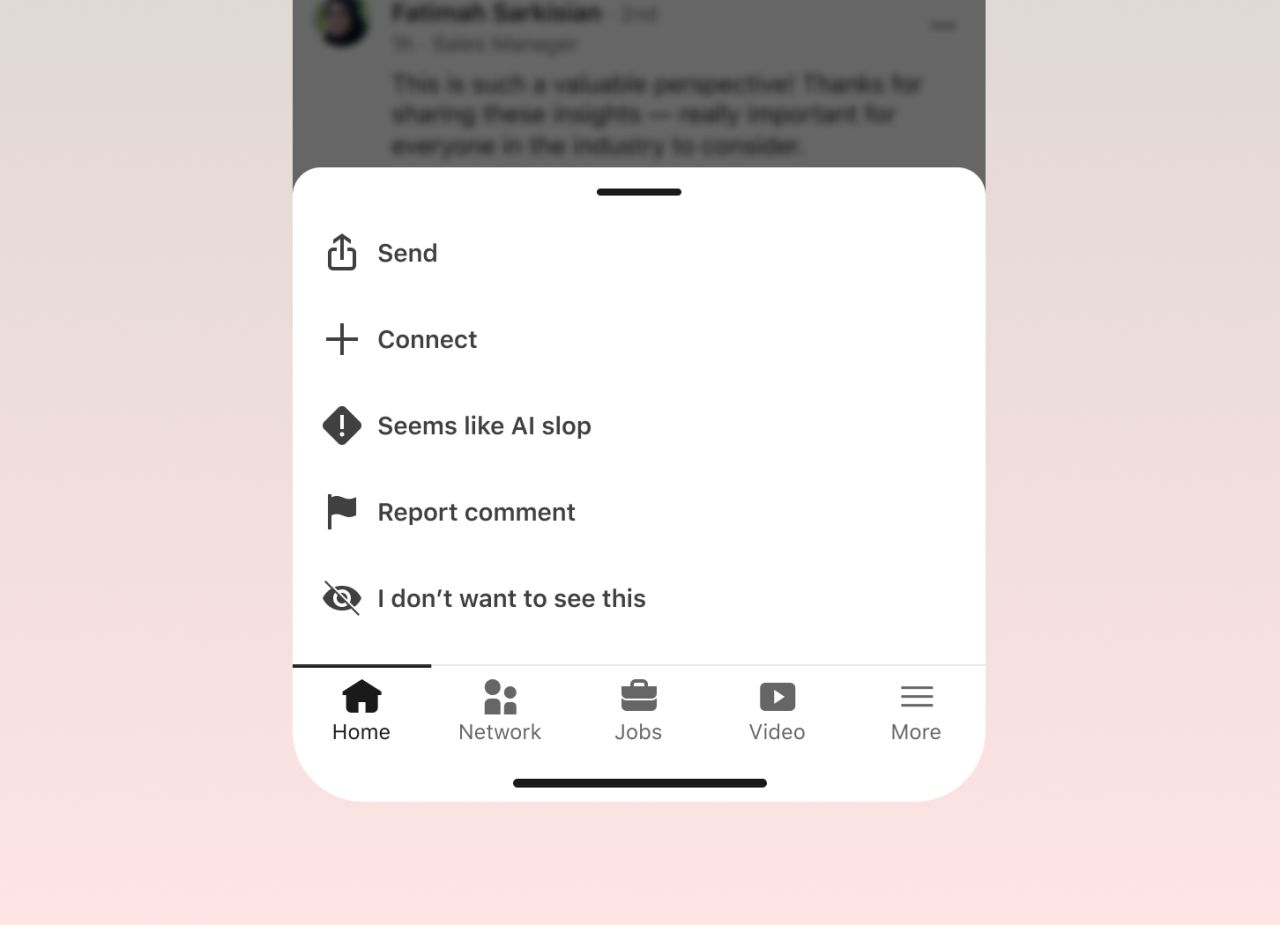
On comments it looks different. In one of the screenshots attached to Srinivasan's post, the comment menu opens as a mobile bottom sheet with five rows: Send, Connect, then "Seems like AI slop", then Report comment and I don't want to see this. The comment sitting above that open menu reads "This is such a valuable perspective! Thanks for sharing these insights", which is about as on-the-nose as a demo gets.
That does not mean it is live for you yet. It has not shown up on comments in my account, which fits the word "ramping" that Srinivasan chose.
Here is his sentence:
"We are ramping the ability for members to tell us if they believe a post or comment seems like AI slop. Slop is hard to define and the definition changes; this lets us tune our models and make better feeds."
Two things in there barely got quoted.
First, comments. "A post or comment" is right there, and the screenshot shows it working. Most of the feed presented comment flagging as something coming later.
Second, why humans instead of an algorithm. Srinivasan says the definition of slop keeps moving, so there is no fixed rule to code. They need continuous human labelling to keep the models current. He also drew a line worth keeping: "AI and slop are not the same thing; many people refine thoughts with AI."
What to do now: before you flag something, ask whether the content bothered you or the fact that a model helped write it. The button is aimed at hollow posts, not at everyone who used AI along the way.
2. Your reports do not cost anyone reach
This is where almost everyone writing about it went wrong.
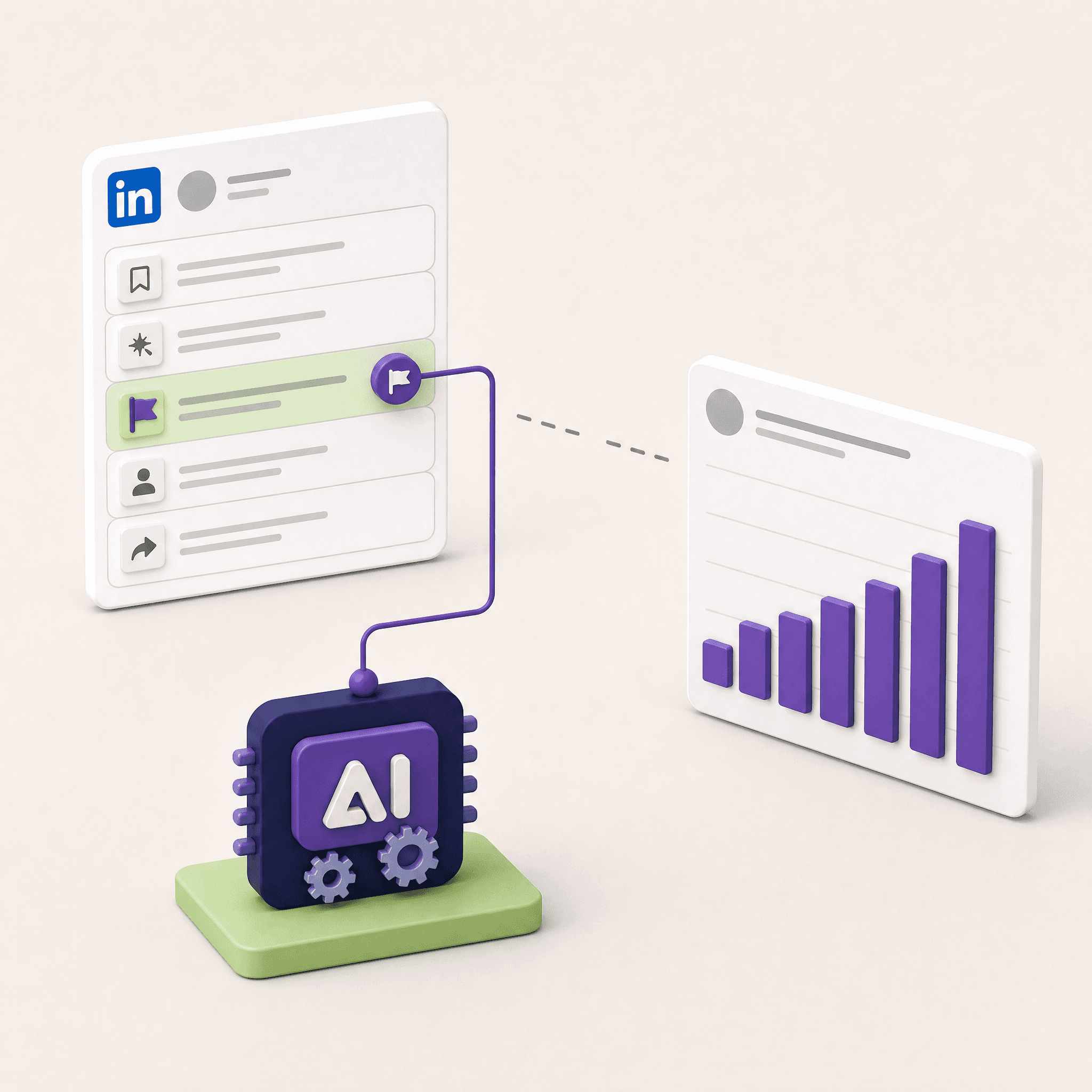
Srinivasan's post contains two separate announcements. One is the button, and its output is a training signal ("this lets us tune our models"). The other is a different sentence entirely:
"We are ramping up a series of new and improved classifiers that identify if a post is AI-slop or generally low-quality content. This will reduce the amount of AI slop you might see in suggested content and content from outside your network."
That is an automated filter, meaning a model that scans every post and tags it "slop" or "fine" with no human involved. Member reports do not appear in that sentence at all. And the penalty is narrowly scoped: suggested content and reach from outside your network. Nowhere, in his post or in the coverage, does anyone say your reach to followers and connections is affected.
It lines up with the crackdown LinkedIn announced back in May, when Laura Lorenzetti, VP of Global Editorial, said they were reducing distribution for generic AI content and reported 94% accuracy in early tests of the classifier.
Out-of-network reach is the times LinkedIn shows your post to somebody who does not follow you and has never heard of you, inside their feed, as a recommendation. That is how new followers arrive, and how leads arrive.
The mechanism runs like this:
You post → the filter scans it → if it gets tagged as slop, LinkedIn stops surfacing it to people who don't know you → your followers and connections keep seeing everything → your impression count holds roughly steady, and the flow of new people closes
And that is the problem. The post does not look like a failure. It has likes, it has comments, it has impressions. It just stops bringing you anyone new, and there is no line in your dashboard for that.
What to do now: open your post analytics and look for the followers versus non-followers split, then compare the last two months. If LinkedIn doesn't surface that split for you, the fallback metric is how many new followers you gained per week. A drop there while impressions and comments hold steady is the real signal.
3. The private notice is a test, not a feature
Plenty of write-ups said creators will now get notified when they're flagged. Srinivasan's wording is more careful:
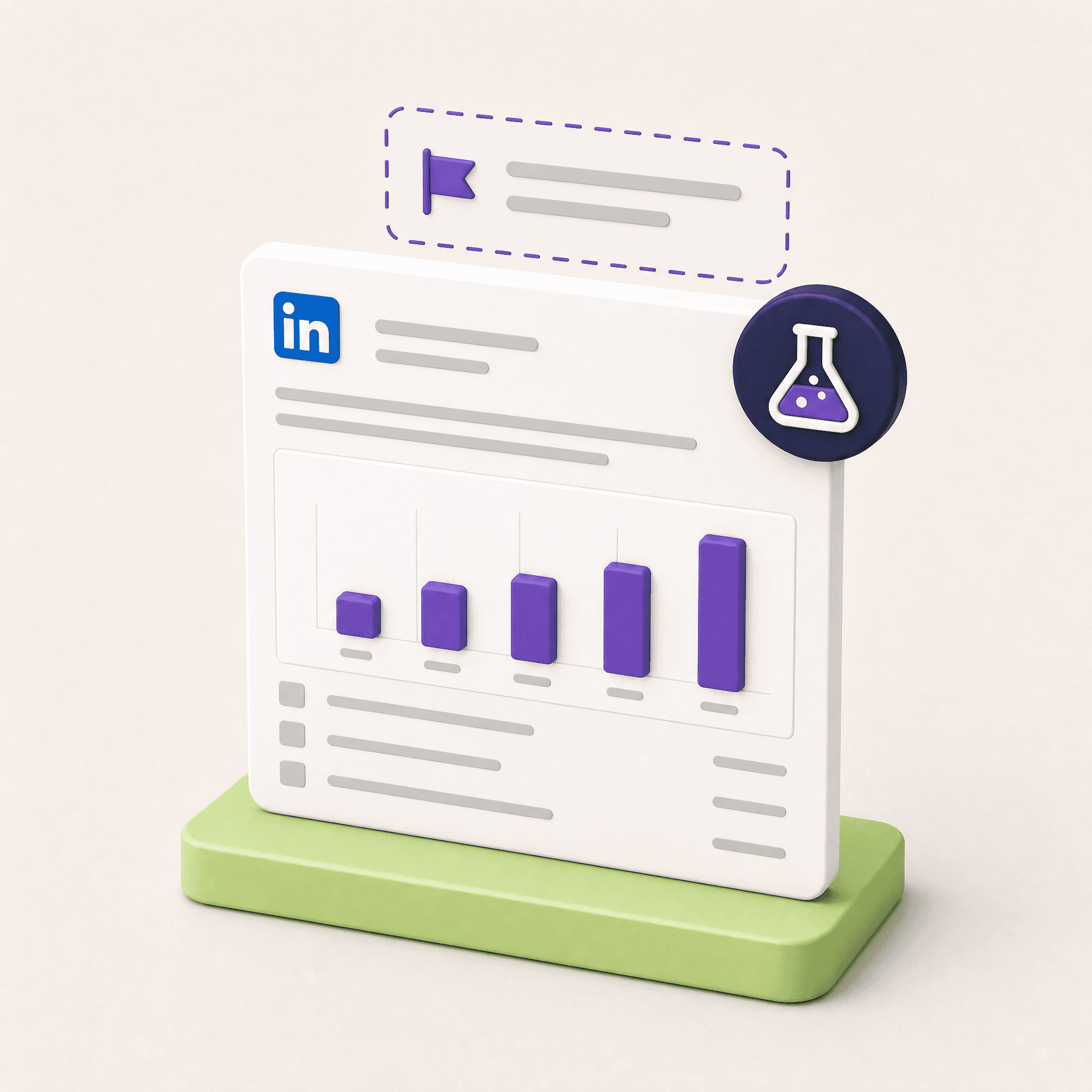
"For anyone who shares content, we will test a way to privately flag, in your analytics dashboard, when members feel your post may have come off as inauthentic or heavy use of AI."
"We will test." It is an announced experiment, and it has not shipped. The exact copy a creator would see has not been published, and neither has the number of reports that triggers it.
One thing is clear: there is no public mark. Nobody sees a "this post was flagged" badge on your content.
What to do now: don't build a workflow around a notification that doesn't exist yet. Check your analytics weekly anyway, and if it arrives, you'll see it there.
4. LinkedIn is deleting its own writing tool
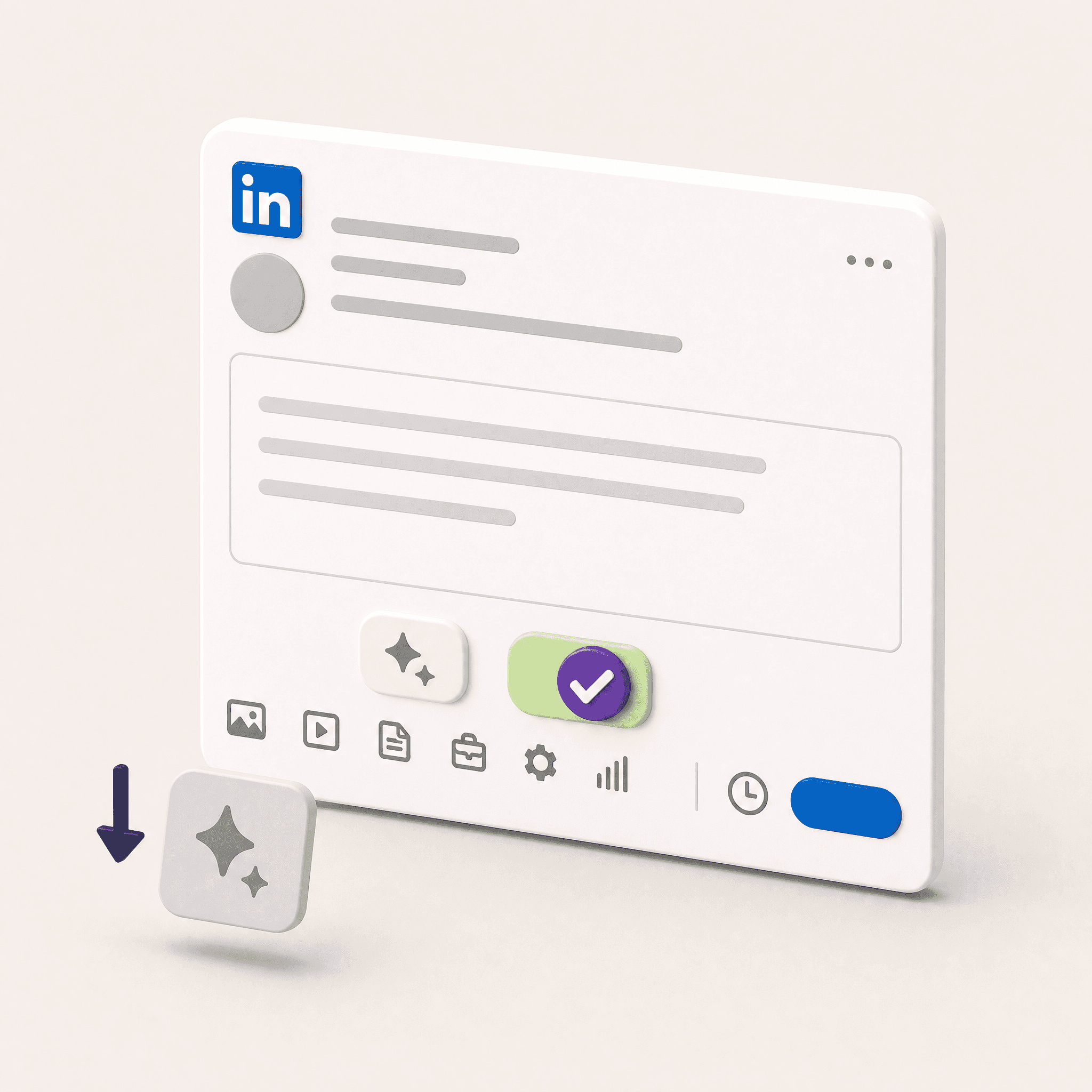
The most interesting part of the whole announcement needs the least explanation. The "Enhance your post" button, the one that generates alternative phrasings inside the composer, is going away. What replaces it fixes spelling and grammar and, in LinkedIn's words, "proofreads your words, but does not change your voice."
LinkedIn built the slop machine into the post box, watched the feed fill up, and is pulling it back out. Three years of "let everyone produce more", and now a sorting of who is actually behind the words.
Two caveats the coverage blurs.
First: what's going is the writing tool in the composer. The Premium AI feature that writes your profile headline and About section, launched in March 2023, was not mentioned in a single one of the eight articles I checked, and it is still documented in LinkedIn's help center. So "LinkedIn is killing its AI" is accurate about posts only.
Second: collaborative articles, the ones LinkedIn itself seeded with AI and invited you to add insights to, are still running. What got wound down there was the automatic gold Top Voice badge, phased out by December 2024. The format is alive.
This is also where Ryan Roslansky is worth revisiting. He was LinkedIn's CEO until April 2026 and has since moved into a senior Microsoft role. In June 2025 he told TechCrunch the post-writing tool "is not as popular as I thought it would be, quite frankly," and explained to Semafor that the bar on LinkedIn is higher because "this is your resume online," and that people posting AI content "get called out." That October he mentioned that almost every email he sends is written with Copilot, including emails to Satya Nadella.
You can call that hypocrisy. I think it's the most honest admission to come out of there this year. An email drafted with AI and a post written instead of you are two different things, and it took LinkedIn three years and a choked feed to say so out loud.
What to do now: if anyone on your team uses the Enhance button as their only drafting step, replace it this week with a process where a person writes the first draft and AI sharpens it. The button is disappearing anyway.
5. The numbers behind the timing
Pangram Labs scanned just over a million posts and published on July 9. 40.5% of long-form LinkedIn posts, meaning anything over 250 words, were fully AI-generated. That is the highest share of any platform they measured, against a 13.8% average across the rest.
LinkedIn made up about a third of the posts scanned and roughly 62% of all the AI content found. Srinivasan, for his part, said LinkedIn blocks hundreds of thousands of automated comment attempts a day.
While we're here, one number is circulating that I could not verify: 78.2 million fake accounts blocked "in a single quarter per the March 2026 transparency report." LinkedIn publishes that report twice a year, not quarterly, and the figure traces back to two marketing blogs selling LinkedIn automation tools. No source.
What to do now: before you quote a statistic about AI on LinkedIn, check the primary source. Pangram's 40.5% is documented. Most of what's circulating is less so.
6. What LinkedIn did not answer
I went through the announcement, eight articles, and the original post. Three questions came back empty, and none of them are small.
There is no appeals process. It isn't mentioned anywhere. If your content gets tagged, there is no stated route to ask for a review.
There is no stated threshold. How many reports it takes for anything to happen, LinkedIn hasn't said.
There is no comment on abuse. This button will get pointed at competitors, at people someone disagrees with, and at whoever annoyed somebody at 7am. Colin Steele, a LinkedIn ghostwriter, told Forbes the feature is "ripe for abuse." LinkedIn has not responded to that publicly.
I'm glad they're fighting slop, and in the same breath, a reporting system with no appeal is a system betting that reporters always mean well. That isn't a bet I'd take on a platform with a billion members.
7. If you write in English as a second language, read this part
This is the section that made me stop mid-draft.
A Stanford study (Liang et al., arXiv:2304.02819) ran seven commercial AI detectors over real TOEFL essays. Every essay in the sample was written by a human, no code involved. The detectors tagged 61.3% of them as machine output, and one detector hit 97%. On essays by writers whose first language is English, those same detectors were wrong less than 10% of the time.
The reason is mechanical. Somebody writing in a second language tends toward a tighter vocabulary and more predictable structures, and that is exactly the statistical signature detectors read as "machine."
Which puts an Israeli business writing English for American buyers squarely in that category.
To be fair: the study tested an earlier generation of detectors, and the company behind that 40.5% figure claims in a paper of its own that its tool is free of the bias. That's a vendor's claim about itself, with no outside validation. As for Hebrew, I found no study at all. I don't know the error rate of a filter like this on Hebrew, and anyone who tells you they do is guessing.
What to do now: if you publish in English, put at least one thing in every post that a detector cannot generate. A specific number from last month, a client or tool by name, a date, or an opinion someone could argue with. It protects your reach, and it is the same thing that made a post good before this button existed.
The bottom line
LinkedIn is making one move this year: putting "who is actually behind these words" back at the center. Reports from humans, automation blocked, its own writing tool deleted, verification expanded.
Which means the thing protecting your reach is the least copyable asset you own. What you've done, what you think, and the specifics only you have.
That was already true. It's just enforceable now.
So if a stranger read your last ten posts tomorrow morning with your name stripped off them, what in there would tell them it was you?
FAQ
What is the "Seems like AI slop" button on LinkedIn?
A reporting option launched on July 30, 2026, available from the three-dot menu on a post. Tapping it hides the post from the reporter's feed and sends a signal to LinkedIn's systems. Per Chief Product Officer Hari Srinivasan, the reports are used to tune detection models, because the definition of slop keeps shifting and can't be fixed as a rule.
Can you flag comments too, or only posts?
Both. Srinivasan's announcement says "a post or comment" explicitly, and a screenshot attached to his post shows the mobile comment menu: Send, Connect, "Seems like AI slop", Report comment, and I don't want to see this. He uses the word "ramping", which suggests a staged rollout, so the option may not have reached your account yet.
Does reporting a post reduce its reach?
Not directly. LinkedIn announced two separate mechanisms: reports train the models, and automated classifiers reduce distribution for content identified as slop. That reduction is scoped to suggested content and out-of-network reach. No threshold of reports triggering any action has been published.
Will I be notified if people flag my content?
LinkedIn said it will test a way to flag it privately in your analytics dashboard when members feel a post came across as inauthentic or heavily AI-assisted. That was framed as an experiment rather than a shipped feature, and the exact wording a creator would see hasn't been published. There is no public mark.
Is LinkedIn removing its AI writing tools?
It is removing "Enhance your post" from the composer and replacing it with a tool that corrects spelling and grammar without changing the writer's voice. The Premium AI feature that writes profile headlines and About sections wasn't mentioned in the announcement and is still documented in the help center. LinkedIn's AI-seeded collaborative articles are also still running.
How much LinkedIn content is written by AI?
Per a Pangram Labs study published July 9, 2026, analyzing 1,002,627 posts collected between April and July 2026, 40.5% of LinkedIn posts over 250 words were fully AI-generated, the highest share of any platform measured. LinkedIn accounted for about a third of posts scanned and roughly 62% of all AI content found. The cross-platform average was 13.8%.
Is there an appeals process if my content gets flagged?
No appeals process, no report threshold, and no official response to concerns about abuse of the button have been published. All three remain open in LinkedIn's announcement and in the press coverage.
Are AI detectors less accurate on writers whose first language isn't English?
Per a Stanford study (Liang et al., arXiv:2304.02819) testing seven commercial detectors on human-written TOEFL essays, the detectors wrongly flagged 61.3% of them as machine-generated, against under 10% for essays by native English writers. The study tested an earlier generation of detectors, and some vendors claim their tools are free of the bias, without outside validation. No dedicated study exists for Hebrew.
Written by Hanita Yudovski, an outsourced marketing manager focused on LinkedIn as a growth engine alongside AI agents for B2B businesses, and host of the "What's the Story With?" podcast. Updated August 2026. Written with AI tools, human strategy and human editing.
Sources: Hari Srinivasan's LinkedIn post · TechCrunch · Forbes · Engadget · The Register · SiliconANGLE · Fortune · Pangram Labs · Social Media Today · TechCrunch — Roslansky · Semafor · LinkedIn Help · Liang et al., Stanford