← Back to Blog


An AI agent saves time only when you know exactly where a human stops it.
TL;DR: An AI agent for business is software built on a language model that takes a goal, decides its own steps and carries them out inside your tools (docs, website, CRM, messaging). Agents save time on work that repeats, has a clear definition of done, and is quick to check. They fail on judgment calls and on anything you can't undo, which is why a human should approve before anything leaves the building. Gartner expects over 40% of agentic AI projects to be canceled by the end of 2027.
Most businesses asking for "an AI agent" right now need something less glamorous: a defined workflow, one or two steps where the model thinks for itself, and a single clear point where a person says yes.
I build agents for clients and run a set of my own, so I have an obvious interest in you ordering one. That's exactly why I'd rather tell you up front where they earn their keep and where they will quietly break something.
What an AI agent actually is
An AI agent is a program built on a large language model. You give it a goal ("draft an article on this topic and upload it to the site as a draft"), and it breaks the goal into steps, chooses which tools to use, does the work, and checks the result before moving on.
The easiest way to see the difference from tools you already use is to ask who decides what happens next:
What triggers it | Who decides the next step | Example | |
|---|---|---|---|
Chatbot | A user's question | The user | A website bot answering pricing questions |
Automation | A fixed trigger | A script written in advance | New form lead → added to CRM → auto email |
AI agent | A goal | The model, inside limits you set | An agent that checks keyword data, proposes topics and drafts posts |

Anthropic, the company behind Claude (so, a vendor with a stake in this), draws the line more sharply. Workflows are systems where models and tools run through predefined code paths. Agents are systems where the model directs its own process and tool use. Their advice is to find the simplest solution that works, and they say outright that this "might mean not building agentic systems at all."
By that definition, a good chunk of what I call "my agents" is really a workflow with a few smart steps. My ego took a small hit when I noticed, and it's also the reason the system is stable. If your actual question is which tools you need in the first place, start with the marketing automation stack for 2026.
How mine run: the OctaLoom agent setup
I build OctaLoom's agents in Claude Code. At the top sits a Head of Marketing agent that owns strategy. Under it, execution agents handle SEO, the blog, social, paid ads and email. The split is deliberate: the agent that plans doesn't execute, and the agents that execute don't decide the message.
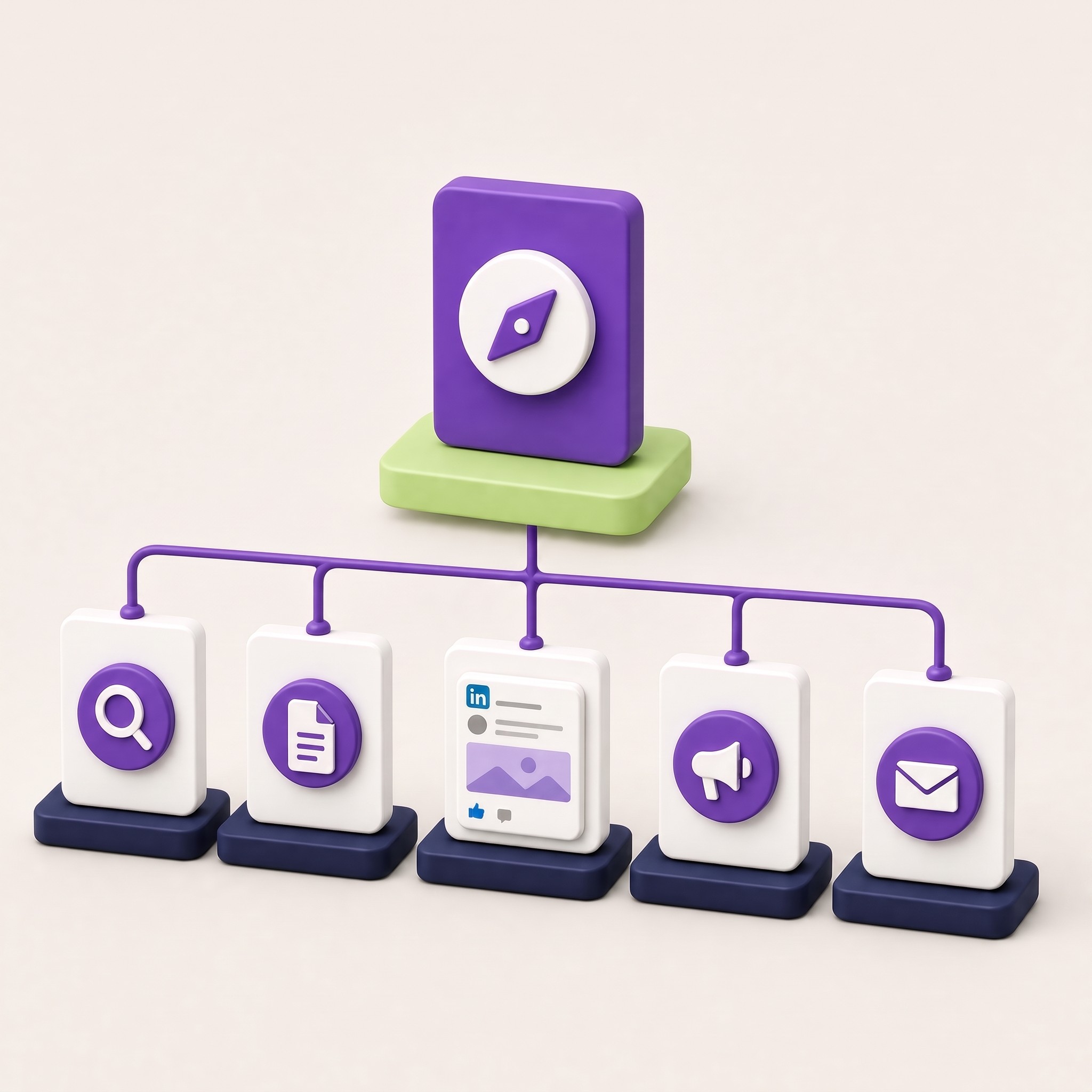
This blog runs inside that setup:
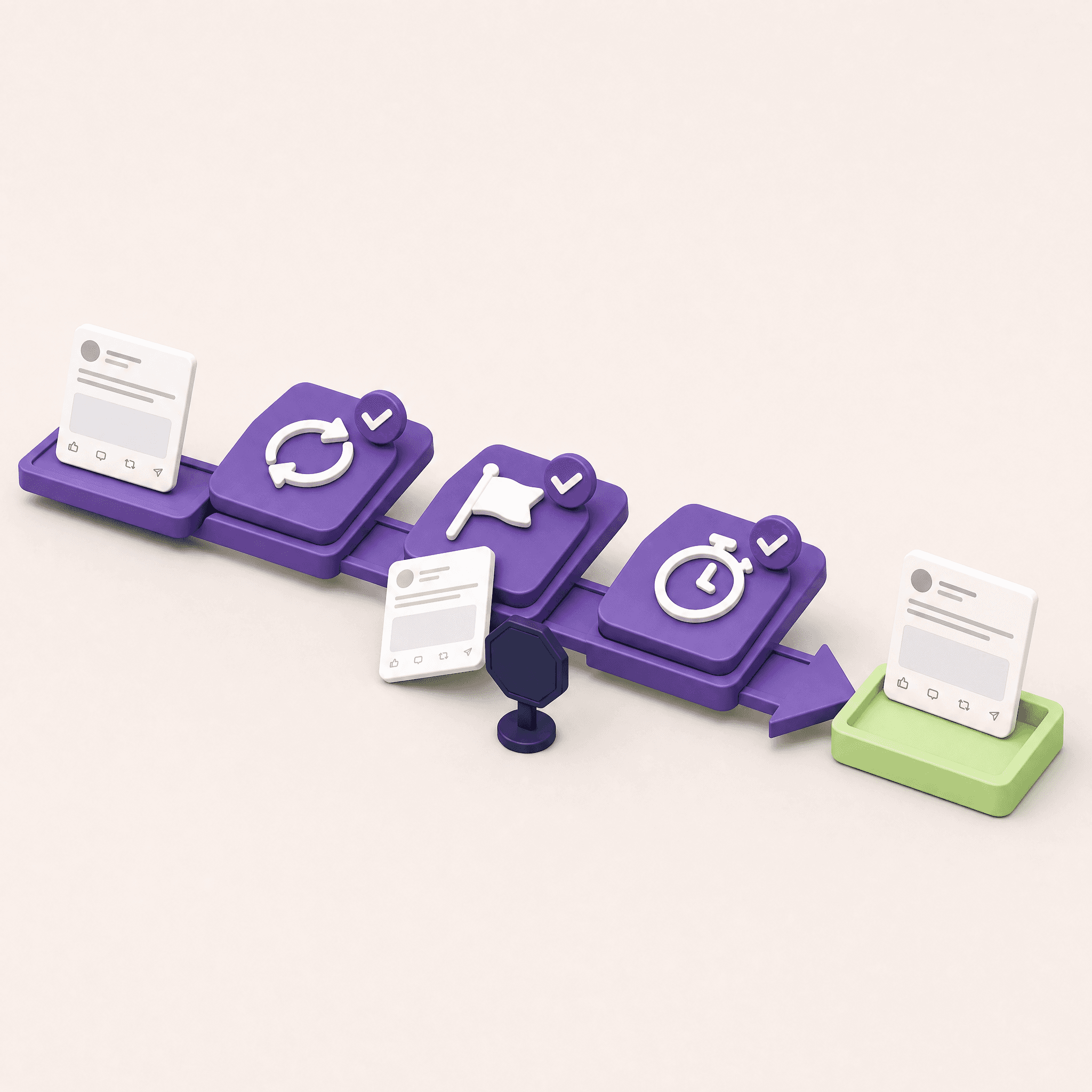
On Monday an agent scans what happened on LinkedIn that week → a planning agent proposes four topics from keyword data and the week's trend → stop one: I approve the week → a writing agent drafts in Hebrew and English and runs EEAT, SEO and AEO checks (three fix attempts, then it stops and reports) → it describes an image idea in words → stop two: the image gets generated only after I approve the idea → the article goes to the website as a draft → stop three: the agent asks "publish?" and publishes only after an explicit yes → updates and approval requests reach me on Telegram.
Those three stops are the whole design. The broader way of working, where AI sets the pace and a human sets the direction, is in my piece on vibe marketing for B2B.
Where AI agents actually save time
Run every task through three conditions before you hand it to an agent. It repeats, it has a clear definition of done, and someone can check the output in a minute or two.
When all three hold, agents are genuinely useful: pulling data and first-pass research, first drafts from a brief, checking work against a list (title length, live links, FAQ present), moving content between systems, reminders and status updates. In the blog setup, those are precisely the parts the agents do.
Drop any one condition and the savings evaporate. A task with no clear finish line turns into an endless revision loop. A task that's hard to check just moves the hours from doing the work to reviewing it (which is somehow more tiring).
So how much time are we talking about? The most solid number I found comes from the Federal Reserve Bank of St. Louis. In a November 2024 survey, workers who used generative AI reported saving 5.4% of their work hours the previous week, roughly 2.2 hours for someone on a 40-hour week. Two caveats: it's self-reported, and it covers generative AI in general with no separate figure for agents. My own estimate for my setup: about 30 hours a month.
Where agents fail (mine included, this week)
This week my planning agent proposed this very article and justified it as "closing the cluster," because articles on what an AI agent is and how to build one were supposedly already published. A check against the sitemap showed neither exists. The most likely source is the topic backlog, where the agent marks a topic "done" the moment it's approved, before anyone has written a word.
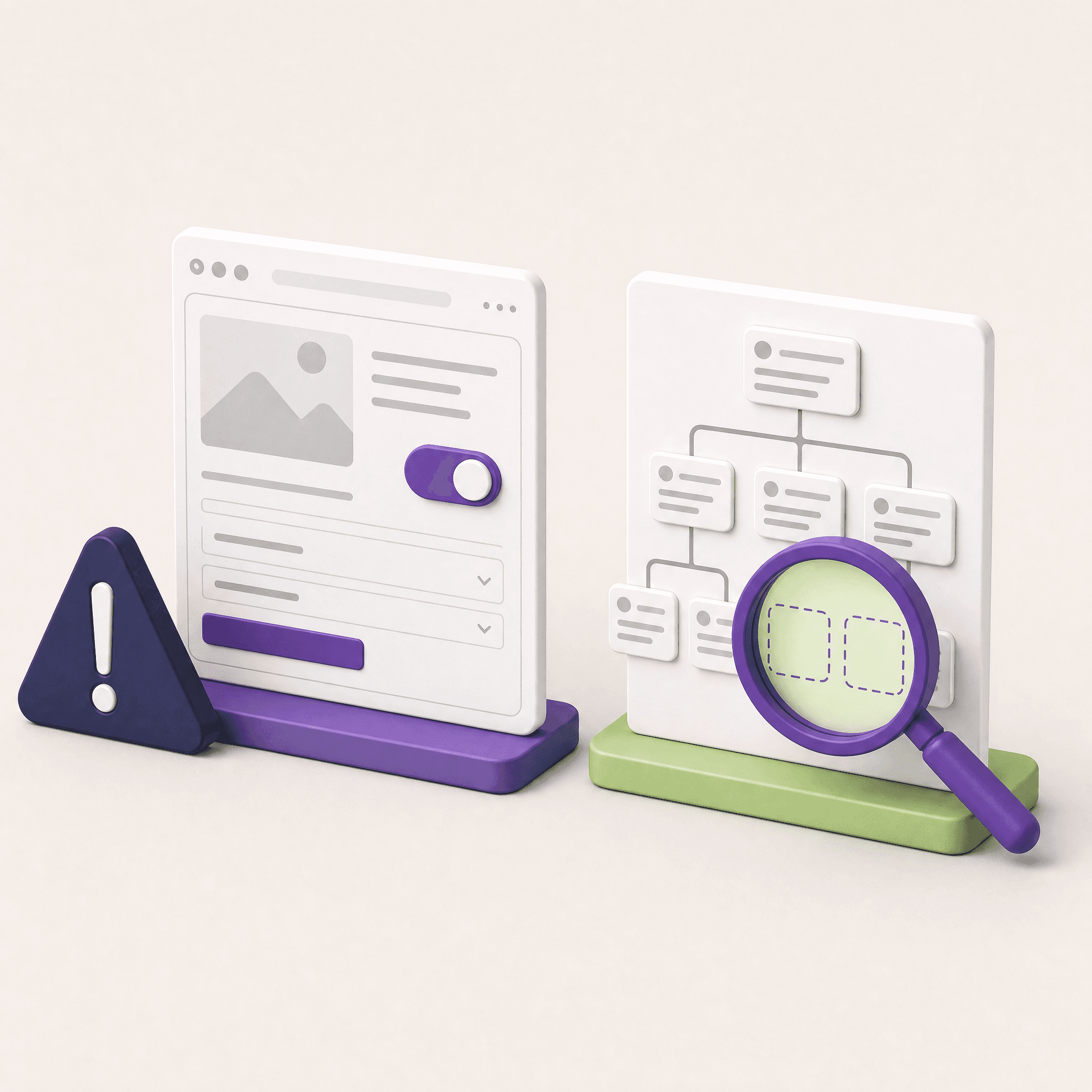
That's the failure I run into most: an agent reporting, with total confidence, a state of the world that isn't real. It happened with images too, when the image model invented text on a timeline (a "2023" and a word that doesn't exist), so every image now gets checked before it goes up. And on the website, a partial update to an article in Framer silently flipped it from draft to marked-for-publishing, with nobody asking it to. Since then every update re-sends the draft flag, which is one more good reason for stop three.
The one that surprised me most was in the writing itself: my writing agent gave its own draft a score of 95, a separate reviewing agent gave the same draft 88. Since then every text goes through an agent that didn't write it, and then through my own eyes and my own edit.
Zoom out and the picture looks similar. Gartner predicts that over 40% of agentic AI projects will be canceled by the end of 2027, due to escalating costs, unclear business value or inadequate risk controls. In the same release, Senior Director Analyst Anushree Verma described most current projects as early-stage experiments "mostly driven by hype," and Gartner estimated that of the thousands of vendors selling "agents," only about 130 offer real agentic features (it calls the rest agent washing). McKinsey's State of AI 2025 lands in the same place: 62% of organizations are at least experimenting with agents, and only 23% say they are scaling an agentic system anywhere in the company.
When an agent publishes content nobody edited, LinkedIn now charges you for it in reach. I broke down how in the AI slop button article.
Four questions before you build an AI agent for your business
Which specific task comes off your calendar? ("Marketing" is too broad. "A weekly newsletter draft built from our last three posts" is something you can build.)
What does "done" look like, and who checks it, in how many minutes?
What breaks if the agent gets it wrong, and can you undo it?
Where is the human stop: before something goes to a client, gets published, or costs money?
If you can't answer the first question crisply, you're early. If the answer to the third is "we can't undo it," the answer to the fourth has to be "before."
Build it yourself or hire someone
If you enjoy tinkering with code and prompts, start alone in Claude Code with one small task, and expect most of your learning to arrive the first time the agent gets something wrong. If you want it running without becoming a side project, you need someone who understands both the marketing and the tooling, because deciding what to give an agent is a marketing decision. I wrote about in-house versus outside help in the fractional CMO services piece, and the agents I build for clients are on the AI tools and agents page.
The bottom line
An AI agent for business is worth it when the task repeats, is clearly defined and quick to check, and when you know in advance exactly where a person stops it. Anywhere else, expect it to create review work that eats the time it saved.
This week, write down three tasks that come back every Monday and run each one through the four questions. Which one passes all four?
FAQ
What is an AI agent for business?
An AI agent for business is software built on a language model that takes a goal, decides its own steps and carries them out inside the company's tools, such as documents, the website, a CRM or messaging apps. Unlike regular automation, the agent chooses its next step within limits you set.
What's the difference between an AI agent and a chatbot?
A chatbot responds to a user's question, and the user decides what happens next. An AI agent takes a goal, breaks it into steps, uses tools and checks its own output, so it can take a task from start to a finished draft.
Where do AI agents save time?
On tasks that repeat, have a clear definition of done and are quick to check: data gathering, first drafts from a brief, checklist reviews, moving content between systems and status updates. In a St. Louis Fed survey from November 2024, generative AI users reported saving 5.4% of their work hours (self-reported).
What can't an AI agent do on its own?
Agents are unreliable on judgment calls, fact-checking and actions you can't reverse. They tend to report states that aren't real with full confidence, so a human should approve before anything is published, sent to a client or spends money.
Does a small business need an AI agent?
Only if there is a specific task that repeats every week and is easy to check. Often a simple automation with one AI step is enough, and Anthropic itself recommends starting with the simplest solution. Gartner predicts over 40% of agentic AI projects will be canceled by the end of 2027.
Should I build an AI agent myself or hire someone?
If you're comfortable with code and prompts, start yourself with one small task. If you want a system that runs without becoming a side project, bring in someone who understands both marketing and the tools, because deciding what an agent does and where it stops is a marketing decision.
Written by Hanita Yudovski. I run LinkedIn systems for B2B companies, from the CEO's profile to employee advocacy programs, and help independents build their presence on LinkedIn. LinkedIn is the field I work in every day, and the AI agents and tools I build myself are how the work gets done. Updated September 2026. This article was produced with the AI agent setup it describes, with human strategy and editing.
Sources: Anthropic: Building effective agents, Dec 2024 (model vendor) · Gartner: over 40% of agentic AI projects will be canceled by end of 2027, Jun 2025 · McKinsey: The state of AI in 2025 · Federal Reserve Bank of St. Louis: The impact of generative AI on work productivity, Feb 2025