← Back to Blog


Pick the companies first, then spend the marketing money.
TL;DR: Account-based marketing (ABM) is a B2B strategy where marketing and sales agree on a fixed list of target companies first, then aim content, ads and personal outreach at the people who make the buying decision inside them. Gartner found that 73% of B2B buyers actively avoid suppliers who send irrelevant outreach, which is exactly the problem ABM is built to avoid. On LinkedIn, ABM runs on three layers: a company list uploaded to Campaign Manager, the founder's profile, and your employees. It fits companies with large deal sizes and a clear ideal customer, and it's a poor fit for cheap products with short sales cycles.
Here's what spray-and-pray looks like on LinkedIn in 2026. A campaign targeting "marketing managers, Israel and US," a healthy impressions number, a few dozen likes, and three leads (one of them a student looking for an internship). The report looks busy, and the pipeline looks exactly like last quarter's. (I've written before about where B2B social budgets usually leak.)
Account-based marketing flips the order of operations. You decide which companies are worth winning, and only then do you spend time and money reaching the people inside them.
I'm Hanita Yudovski. I run LinkedIn for B2B companies (the CEO's profile, the company page, employee advocacy), and I ghostwrite for some of the founders I work with, so the part of ABM that happens on a personal profile is the part I know from the inside. Below: what ABM is, why it works, how to run it on LinkedIn, and who should wait.
What is account-based marketing?
Account-based marketing is an approach in which marketing and sales jointly select a closed list of target companies ("accounts"), map the people who influence the purchase at each one, and build content, advertising and outreach around those people. Success is measured account by account.
The traditional funnel runs like this: broad awareness → leads → qualification → maybe a customer.
ABM inverts it: pick accounts → map the buying group → tailored content and touches → conversation → customer.
To keep this from staying abstract, let's invent a company and follow it through the article. Call it FlowCost (entirely made up). It sells FinOps software, finding and cutting cloud waste, at an average deal of $60K a year. Its ideal customer: SaaS companies with 150+ employees whose AWS bill crossed a million dollars a year and nobody is quite sure why. At every such company, three people shape the decision: the CFO who sees the bill, the VP R&D whose teams generate it, and the DevOps lead who would implement the tool. Hold those three in your head, everything below is aimed at them.
In practice there are three flavors, following the widely used ITSMA model (ITSMA is the research firm that coined the term):
One-to-one: a handful of strategic accounts, each with its own plan.
One-to-few: small clusters of companies with the same problem, say every Series B cybersecurity company in your market.
One-to-many: hundreds of accounts, personalized by industry or role, run mostly through tooling and paid media.
For most of the founders I talk to, the middle option is the right place to start. Our FlowCost sits exactly there: every SaaS company with a swollen cloud bill is one cluster with one pain, and you can talk to all of them in the same language without writing a separate plan per account.
Why ABM beats spray-and-pray
Buyers are filtering you out. A Gartner survey of 632 B2B buyers, run in August and September 2024 and published in June 2025, found that 73% actively avoid suppliers who send irrelevant outreach, and 61% prefer a buying experience with no sales rep at all. Every generic message you blast to a broad list costs money now and quietly burns your name with someone who might have bought next year.
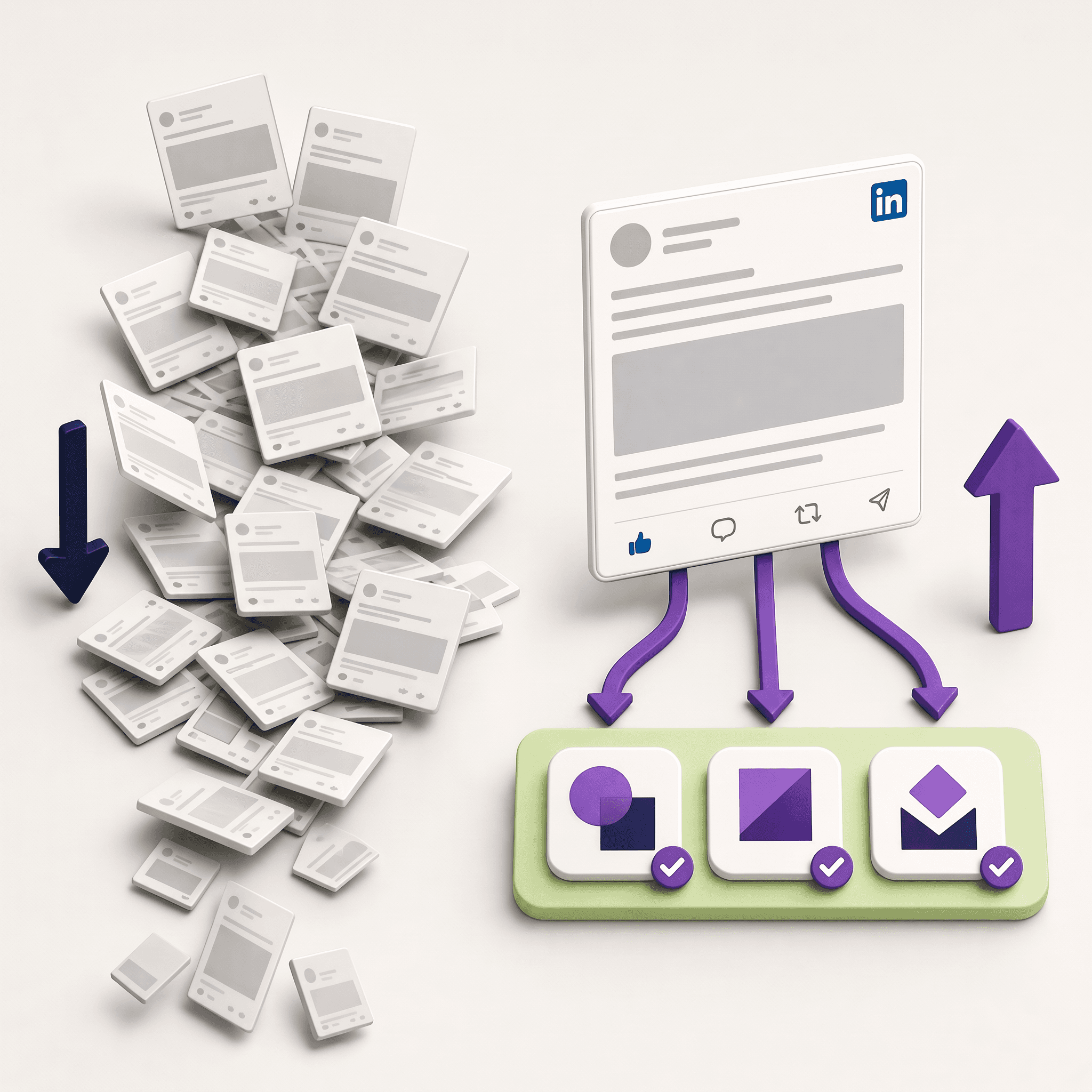
Deals are decided by a group. A B2B purchase has several people at the table: a finance lead, an operations head, someone in IT who can veto the whole thing. A broad campaign reaches one of them by accident. ABM reaches all of them on purpose, with a message that fits each role.
The ROI case is strong, with a footnote. The 2023 ABM Benchmark Study from Momentum ITSMA and the ABM Leadership Alliance (November 2023, led by Rob Leavitt, Partner at Momentum ITSMA) found that 81% of companies measuring ABM ROI said it beats traditional marketing: 36% said significantly higher, 45% somewhat higher.
And beneath the surveys there are specific campaigns with numbers. Refinitiv, the financial markets data provider, ran a LinkedIn ABM campaign that delivered 34% higher CTR than its regular campaigns and a 96% lower cost per lead (LinkedIn's customer story). Visier, which sells people analytics to enterprises, connected account lists to LinkedIn ads and reached 80% engagement across its enterprise target accounts with a 234% higher CTR (Demandbase's case study, written by the vendor about itself, so apply the usual discount). And Blue Yonder, the supply chain software company, built an always-on LinkedIn ABM program of roughly 30 campaigns segmented by account intent stage, and attributed $19M of influenced pipeline and 38 opportunities to it (diginomica, November 2023).
Now the footnote nobody puts on their slide. In the same study, only 52% of companies measure ABM ROI at all, and "proving ROI" sits among their top challenges. So the 81% comes from the half that bothered to measure. I read that as encouraging, and also as a warning: if you start ABM without deciding upfront what you'll measure, six months in you'll have a lot of activity and nothing to show the board.
How to run ABM on LinkedIn
LinkedIn is the natural home for ABM because it's the network where you can see where someone works and what their role is, then reach them with ads and personally in the same place. When it works, the chain looks like this:
Build the account list from your ICP → upload it to Campaign Manager as a Matched Audience → run paid content to the right roles at those companies → the founder connects with and comments on decision-makers' posts → employees engage in the same threads → sales reaches out only once there are engagement signals.
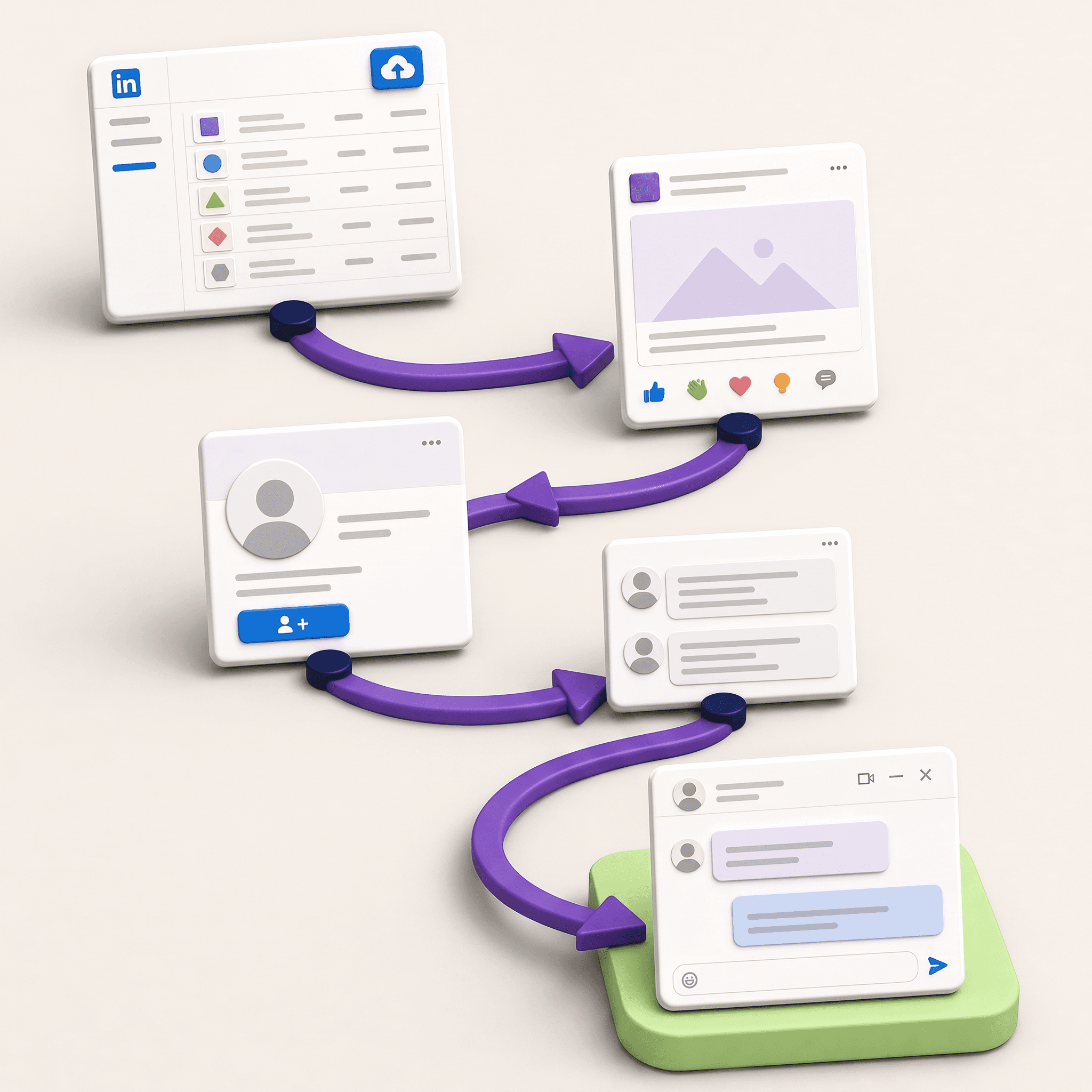
1. The list. Per LinkedIn's Marketing Solutions Help Center, a company list needs at least 300 rows to upload and must match at least 300 members before an ad set can run. The maximum is 300,000 companies (or 20MB), LinkedIn recommends 1,000+ companies, and processing can take up to 48 hours. Add each company's LinkedIn Page URL to the file; it improves match accuracy.
2. The content. Target accounts get content that speaks to their specific problem, ideally from a person. A founder's post promoted to the account list as a Thought Leader Ad lands very differently from a banner off the company page. LinkedIn reports 2x higher average CTR for Thought Leader Ads than single-image ads with the same objective (via Social Media Today, October 2025), and Lenovo measured 6x the engagement of its own sponsored content benchmark (LinkedIn case study, July 2024). For FlowCost this looks like a founder post with a numeric benchmark, "we audited 40 AWS accounts at SaaS companies, these three waste lines showed up in almost all of them," promoted only to the account list.
3. The founder's profile. This is where most LinkedIn ABM quietly falls apart. Ads warm the account, and the personal profile closes the loop: a connection request with real context, a thoughtful comment on the VP Operations' post, a post answering the exact question she asked on a conference panel. The founder's profile is also what AI engines read when they look up your company, so that effort pays twice.
4. Your employees. When your product lead and your customer success manager show up in the same conversations, your company appears in the account's feed from several directions, and nobody paid for those impressions.
5. Sales, last. Outreach waits for signals: visits to your company page, profile views from people on the list, comments. For turning that moment into a real conversation, see how to turn LinkedIn into a sales channel.
And what if your entire market is 40 companies? After filtering by role, you may never reach the 300-member minimum, and Campaign Manager simply won't run the ad set. I used to treat that as a blocker. It's actually the easiest version of ABM: skip the ads, and the founder does every touch by hand, one account at a time.
What six weeks of this look like from the account's side
Take one company on FlowCost's list and watch its feed from the inside.
Week one: the CFO sees a promoted post from FlowCost's founder with the three-waste-lines benchmark. She doesn't comment, but the numbers look uncomfortably like the bill she signed last week, so she saves the post. The same week, her DevOps lead sees a more technical cut of the same content.
Week three: the founder leaves a substantive comment on a post she wrote about 2027 budget planning, with no product mention. Week four: a connection request arrives referencing that thread, and she accepts, because by now she recognizes the name. Week five: she visits his profile, clicks through to the company page, and meanwhile her VP R&D has commented on one of the posts (FlowCost's tracking marks the account as warm).
Only in week six, after three separate engagement signals from the account, does a personal note from sales arrive, and it talks about the exact waste line she saved in week one. No step in that chain was cold, which is why the reply rate on that note looks nothing like any cold campaign you've run.
Who should skip ABM (for now)
This section probably costs me a few prospects, so I'll be plain about it. A fair number of conversations that open with "we want ABM" turn out, ten minutes in, to be a request for more leads, fast, from anywhere. ABM is slow, targeted work, and it's the wrong move if:
Your product is cheap and the sales cycle is short. When a deal is worth a few hundred dollars, the effort per account never pays back. The market consensus, mostly voiced by ABM vendors so take it with the obvious grain of salt, is that below roughly $30K in annual contract value ABM rarely pays back, and the comfortable zone starts around $50K (Userled, DemandScience). FlowCost at $60K a year clears the bar; a $200-a-month product does not come close.
You haven't defined your ideal customer. Before product-market fit, an account list is a guess in a spreadsheet. Figure out who buys and why first.
Nobody owns follow-up. ABM creates conversations with senior people. If nobody answers them within a day, the account goes cold.
Leadership expects results in 30 days. ABM runs on your sales cycle, and in B2B that usually means quarters. Whoever judges it in month one will kill it in month two.
You have no LinkedIn presence. If the founder's profile has been silent since the last funding round and the company page is a ghost town, your ads send senior buyers to an empty storefront.
If three of those describe you, invest in the foundation first: a defined ICP, an active founder profile, and someone running marketing as a system (here's what a fractional CMO actually covers if that's the gap).
Your first 90 days
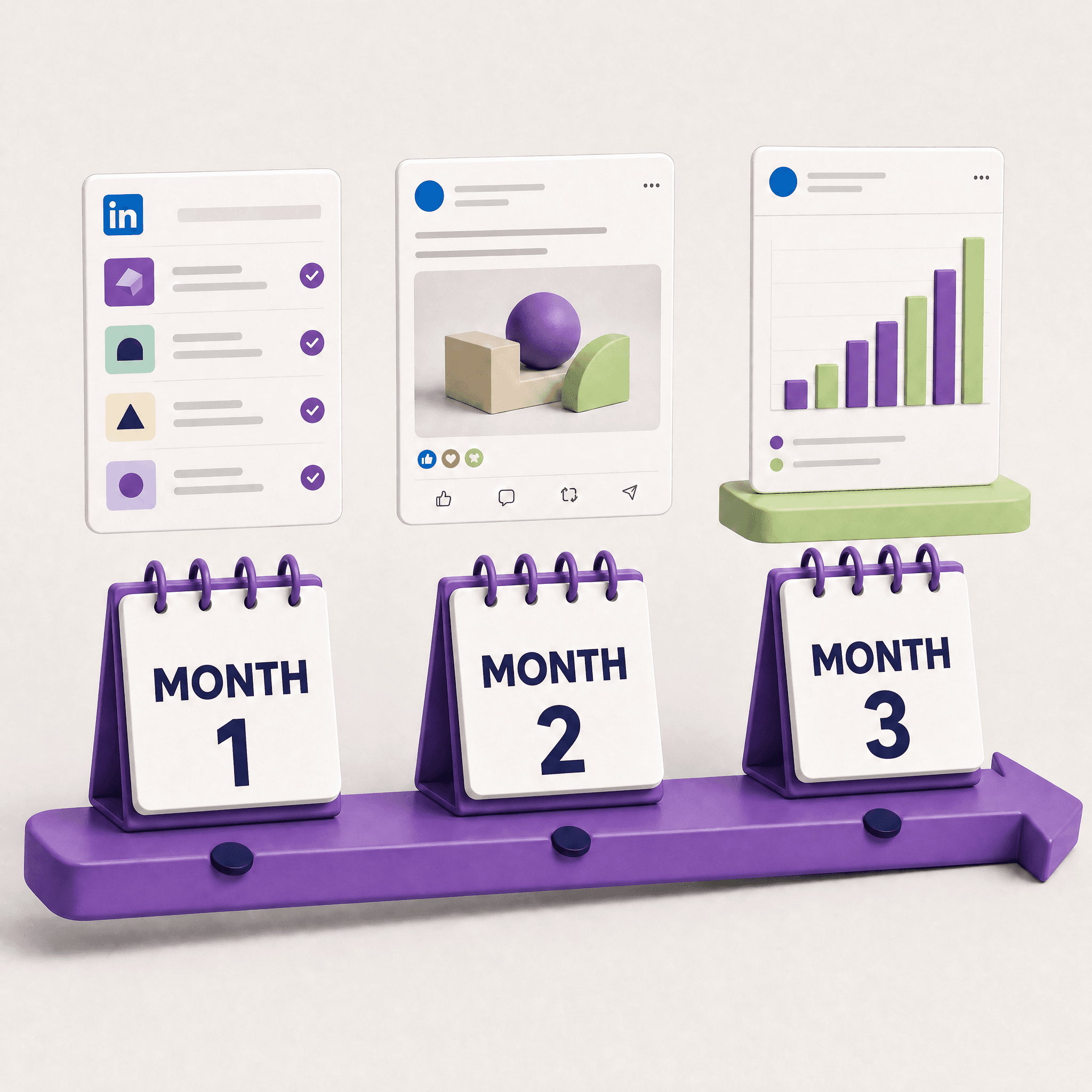
Month 1: Choose your accounts together with sales (a few dozen for hand-run ABM, 300+ if you also want to run ads), map two or three decision-makers at each, and fix the founder's profile so there's somewhere worth landing.
Month 2: Upload the list as a Matched Audience (if it clears the 300-row and 300-member bars), run two content themes built on a real pain those accounts share, and start founder touches with the warmest accounts.
Month 3: Measure per account. How many listed companies engaged, how many conversations opened, what moved into pipeline.
The bottom line
Account-based marketing pays off for companies that know exactly who their customer is and whose deals are big enough to earn real attention. On LinkedIn it works when the list, the ads, the founder's profile and your employees point at the same companies at the same time, and when someone measures it from the start. Those are the pieces I connect in OctaLoom's LinkedIn growth engine for B2B companies.
One exercise for tomorrow morning: write down the ten companies you'd most like as customers, then count how many people inside them you know by name on LinkedIn. What's your number?
FAQ
What is account-based marketing (ABM)? Account-based marketing is a B2B strategy where marketing and sales jointly select a list of target companies, map the decision-makers at each one, and build content, advertising and personal outreach around them. Success is measured by what happens inside those accounts.
Does ABM actually work for B2B? In the 2023 ABM Benchmark Study by Momentum ITSMA and the ABM Leadership Alliance, 81% of companies that measure ABM ROI reported higher returns than traditional marketing. Only 52% of companies measure ABM ROI at all, so define your metrics before you start.
How is ABM different from traditional B2B marketing? Traditional marketing starts with broad reach and filters leads along the way. ABM starts with a closed list of companies and focuses all effort on them. Gartner found that 73% of B2B buyers actively avoid suppliers who send irrelevant outreach, which is the advantage of a targeted approach.
How do you run ABM on LinkedIn? Upload a company list to LinkedIn Campaign Manager as a Matched Audience, run paid content to the relevant roles, and have the founder and employees engage personally with decision-makers at those companies. Sales outreach follows once there are engagement signals.
How many companies do you need for a LinkedIn ABM campaign? According to LinkedIn's Help Center, a company list needs at least 300 rows and must match at least 300 members to run. LinkedIn recommends 1,000 or more companies, the maximum is 300,000, and processing can take up to 48 hours.
Who should not use account-based marketing? Companies with low-priced products and short sales cycles, companies without a defined ideal customer, teams with nobody owning follow-up, leadership expecting results within a month, and companies with no active LinkedIn presence.
At what deal size does ABM pay off? The market consensus, mostly from ABM vendors themselves, is that below roughly $30K in annual contract value the per-account effort rarely pays back, and the comfortable zone starts around $50K. A good non-financial alternative test: a buying committee of three or more people and a sales cycle of two months or longer.
Written by Hanita Yudovski, an outsourced marketing manager focused on LinkedIn as a growth engine alongside AI agents for B2B businesses. Updated September 2026. Written with AI tools, human strategy and human editing.
Sources: LinkedIn: Refinitiv customer story · Demandbase: Visier case study · diginomica: Blue Yonder's always-on LinkedIn ABM program, Nov 2023 · LinkedIn: Lenovo Thought Leader Ads case study, July 2024 · Social Media Today on TLA performance, Oct 2025 · Userled: is ABM right for my company · DemandScience: ABM fit criteria · Gartner via Demand Gen Report: B2B buyer survey, June 2025 · Gartner press release · Momentum ITSMA & ABM Leadership Alliance: 2023 ABM Benchmark Study · LinkedIn Help: Company list targeting in Campaign Manager · OctaLoom: LinkedIn Growth Engine